LED wall hire
An LED wall is worth it when the picture needs to look large and clear even in daylight and under bright stage lighting. At Event-Solution AG you hire our own LED wall with a 2.6 mm pixel pitch, including planning, setup, playback and support from our own technicians, in Bern, Biel/Bienne and across Switzerland.

LED wall instead of a projector: when it pays off
An LED wall produces its own light. A projector throws light onto a surface, and every other light in the room competes with it. That is why the LED wall has a clear advantage here:
- Bright rooms and daylight. Halls with large windows, afternoon events or events in a marquee. The LED wall stays vivid where a projected image fades.
- Bright stage lighting. If speakers need to be well lit for the audience and the camera, the stage lighting hardly affects the wall.
- Large images. There is no need for throw distance for a projector or a clear light path across the hall.
- No shadows. Anyone standing in front of the wall or walking past it casts no shadow on the image. The stage can be used right up to the screen surface.
In a darkened hall with an image of moderate size, projection is often the simpler solution. What matters there is explained on the Projector and screen hire page.
Pixel pitch in simple terms
An LED wall is made up of a great many individual points of light. The pixel pitch indicates how far apart the centres of two neighbouring points are, measured in millimetres.
- Small pixel pitch: the points sit close together. The image looks smooth even from close up, and text and details stay sharp. The audience can sit close to the wall.
- Larger pixel pitch: from close up you can see the grid of points. From a long distance, such as on a festival site, this is no longer noticeable.
So the deciding factor is the distance to the audience. A rough rule of thumb in the industry: the smallest sensible viewing distance in metres is roughly the pixel pitch in millimetres. An even finer grid puts more pixels on the same area and means more effort, but from a few metres away the audience can no longer see the difference.
Our LED wall has a 2.6 mm pixel pitch. That is a fine grid for conference halls, banqueting halls, foyers and stages. From around 3 m away the image looks steady, and presentations and text remain easy to read. In most halls the front row sits further away than that. Because it is our own wall, our technicians set it up and look after it during the event.
Size and format of the LED wall
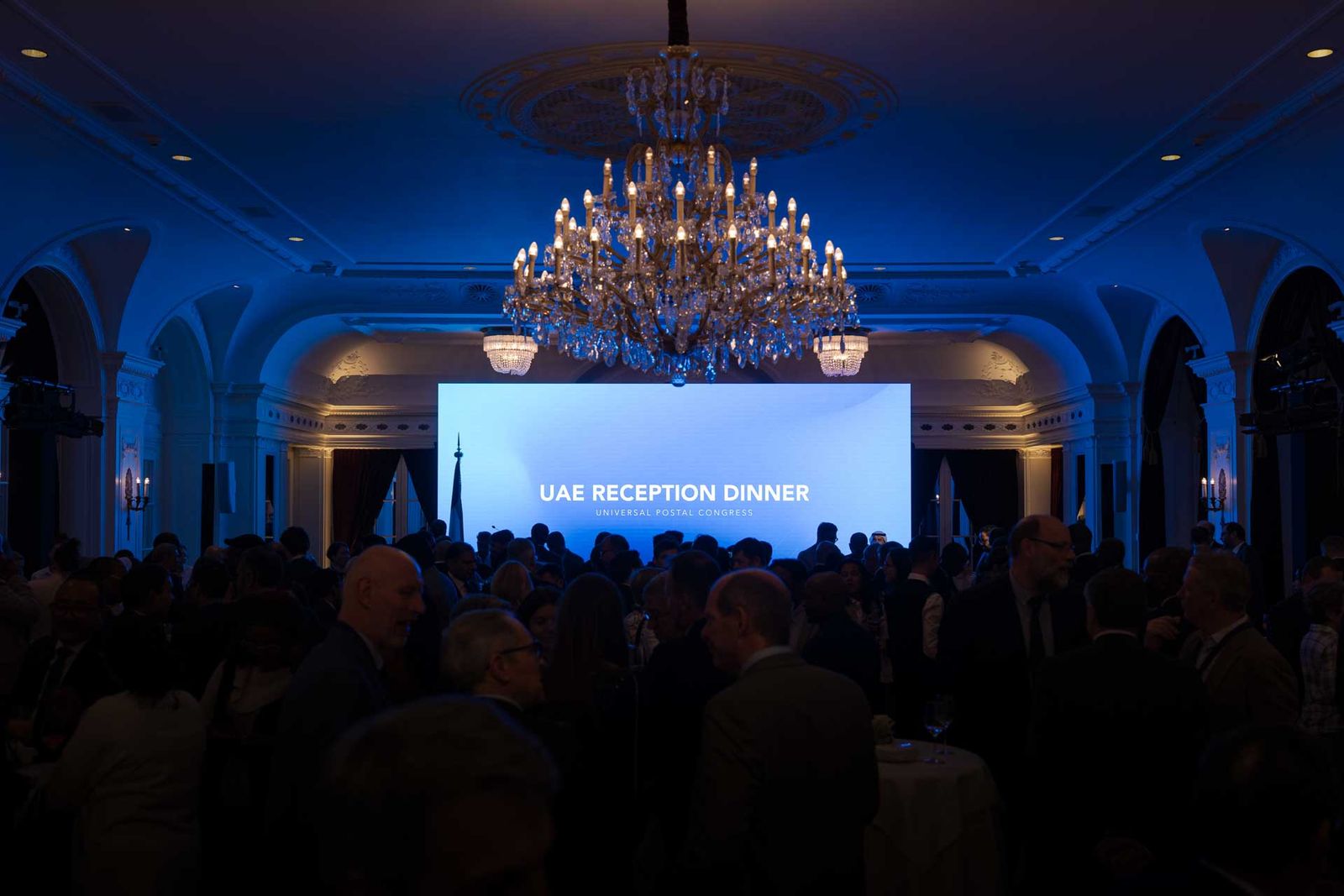
An LED wall is assembled from modules, so its width and height can be adapted to the room. The wall at the Bellevue Palace was 7 m wide and 3.5 m high, twice as wide as it was high. Wide formats like this work well as a stage backdrop: the presentation runs in the middle, with space alongside for the camera feed, a logo or the current programme item.
Three things determine the right size:
- Ceiling height and stage. The bottom edge of the wall must be high enough for the back rows to see over the heads in front. The ceiling sets the upper limit.
- Distance to the audience. The further away the back row sits, the larger the image has to be for text to remain legible.
- Content. A pure stage backdrop can be very wide. A presentation in 16:9 format needs enough height above all.
We will work out which size suits your hall when you send us your enquiry.
Content and playback
Every LED wall has a fixed resolution in pixels, which results from its size and pixel pitch. We give you these dimensions in advance. Graphics and videos created for exactly these dimensions look best on the wall. You can usually use presentations in 16:9 format unchanged, and we fit them into the picture.
Playback runs through our image and video control. It switches between presentation, videos, camera feed and holding slide. The sound from videos goes straight to the sound system in the hall.
Three tips for preparation:
- Send content early so that we can test it on the wall before the event.
- Bring videos as files, not as links from the internet.
- If the event is filmed or streamed, the wall and the cameras have to be matched to each other, otherwise the picture may flicker in the video. More on this under Livestream.
LED wall hire: setup, weight and space
An LED wall is heavy. It stands on its own structure on the floor or hangs from a truss structure or from rigging points in the ceiling. Before every job we check the following with the venue:
- Load capacity: can the floor or the stage take the weight? Are there certified rigging points?
- Access and delivery: how close can the van get to the hall? Is there a goods lift, and how wide are the doors and corridors?
- Power: the wall needs its own power connection with adequate fusing.
- Space behind the wall: for cables, equipment and access in case of a fault.
- Setup time: the wall and the content must be tested before the start. Depending on the hall, we therefore set up the day before or early in the morning.
The easiest way is a site visit or a plan of the hall with dimensions.
LED wall price: what affects the cost
We do not give fixed prices here, because every LED wall is built differently. These points determine the effort involved:
- Size of the wall, meaning the number of modules
- Standing on the floor or flown
- Access to the hall, delivery and setup time
- Length of hire and number of days on site
- Playback, image and video control, cameras
- Support from technicians during the event
With this information we will prepare a free quote with no obligation.
Projects: LED wall at the Bellevue Palace Bern
- Alpenda annual conference (2026): Our own 5 x 2.5 m LED wall with a 2.6 mm pixel pitch, plus white front light, ambient lighting, microphones, preview monitors and sound reinforcement with L-Acoustics Syva. View project
- Event with LED wall (2025): A 7 x 3.5 m LED wall, plus stage, lighting and sound reinforcement with L-Acoustics Syva. View project
If you would like to hire an LED wall, send us the location, date, hall and planned content via the enquiry form.