AI simultaneous interpretation for conferences and events
With AI simultaneous interpretation, artificial intelligence translates the speeches into other languages as they happen, with no interpreter booth at all. Your guests listen on their own phone or on a receiver with headphones that we bring along. That way everyone can follow, including people who have no smartphone or headphones with them.

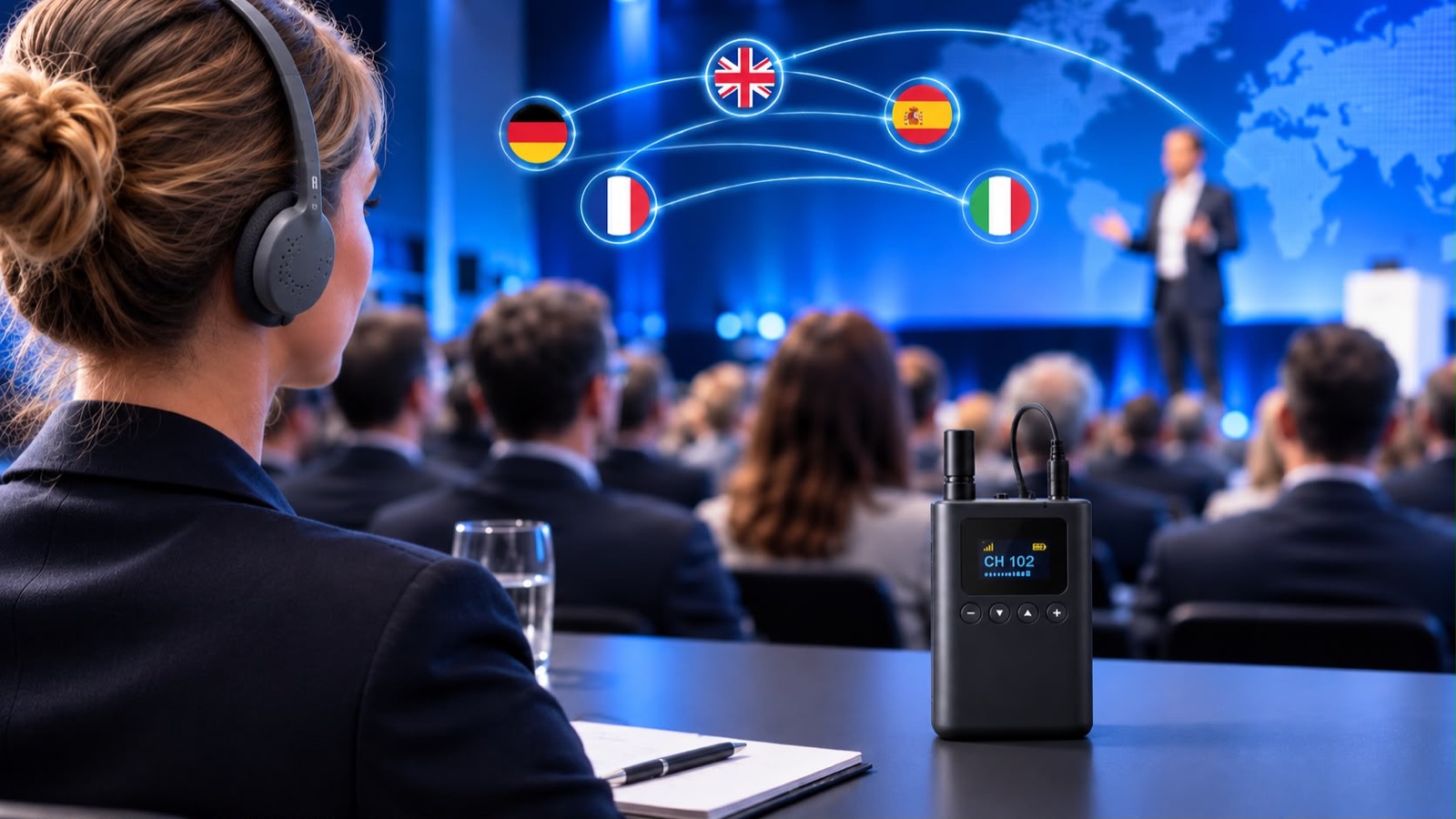
How AI simultaneous interpretation works
- Source audio: Whoever is speaking uses a microphone. We take the sound directly from the mixing desk, not through a room microphone. The cleaner the source audio, the better the translation.
- Translation: The AI converts the speech into text, translates it continuously and speaks the translation with a synthetic voice.
- Output: Guests hear the translation on their own phone or through our receivers with headphones.
The translation runs over the internet. That is why the hall needs a stable connection, ideally by cable rather than the guest Wi-Fi. We clarify this with the venue in advance.
Hybrid: phones and receivers in the same hall
We usually combine two approaches. Some guests listen on their own phone. For everyone else, we send the translation via our portable transmitters to receivers with headphones, which we hand out at the entrance.
The reason is simple: not everyone has headphones with them, not every phone is charged, and not everyone wants to use their own phone for this. With our receivers, everyone can still follow. Headphones are included.
The same tips apply to the receivers as to any interpretation system: label the channels at the entrance, briefly explain how to use them and collect the devices at the exit. More on this under Interpretation system hire.
AI or interpreters?
AI interpretation does not replace every interpreter. As a rule of thumb:
| Situation | Suitable solution |
|---|---|
| Talks and presentations in clear language | AI interpretation |
| Additional languages that do not justify a booth | AI interpretation |
| Hall with no room for interpreter booths | AI interpretation |
| Negotiations, votes, legally sensitive content | Interpreters |
| Lively discussions, humour, lots of technical terms | Interpreters |
Interpreters pick up nuances, know the context and ask when something is unclear. AI is fast and knows many languages, but it can misunderstand names, abbreviations or technical terms. The conventional solution with booths is described on the Simultaneous interpretation page.
Confidentiality
For the translation, the audio goes over the internet to an online service. For confidential meetings, an infrared interpretation system is therefore the safer choice, because the signal does not leave the hall.
For guests with hearing aids
Our receivers can be connected to induction neck loops. Guests with hearing aids then hear the translation directly in their own hearing aid, without headphones. This works with hearing aids that have a telecoil.
What we need for your enquiry
- Date, venue and approximate number of guests
- Language at the lectern and the target languages you need
- How many guests need one of our receivers, if you already know
- Programme with talks, discussions and breaks
Send us these details via the enquiry form and you will receive a free quote with no obligation.