How many interpreters and booths does my event need?
How many interpreters an event needs depends mainly on the number of target languages: for each target language, plan one booth and at least two interpreters, who take turns about every half hour. This overview comes from Event-Solution AG in Münchenbuchsee near Bern, which supplies interpretation equipment throughout Switzerland.

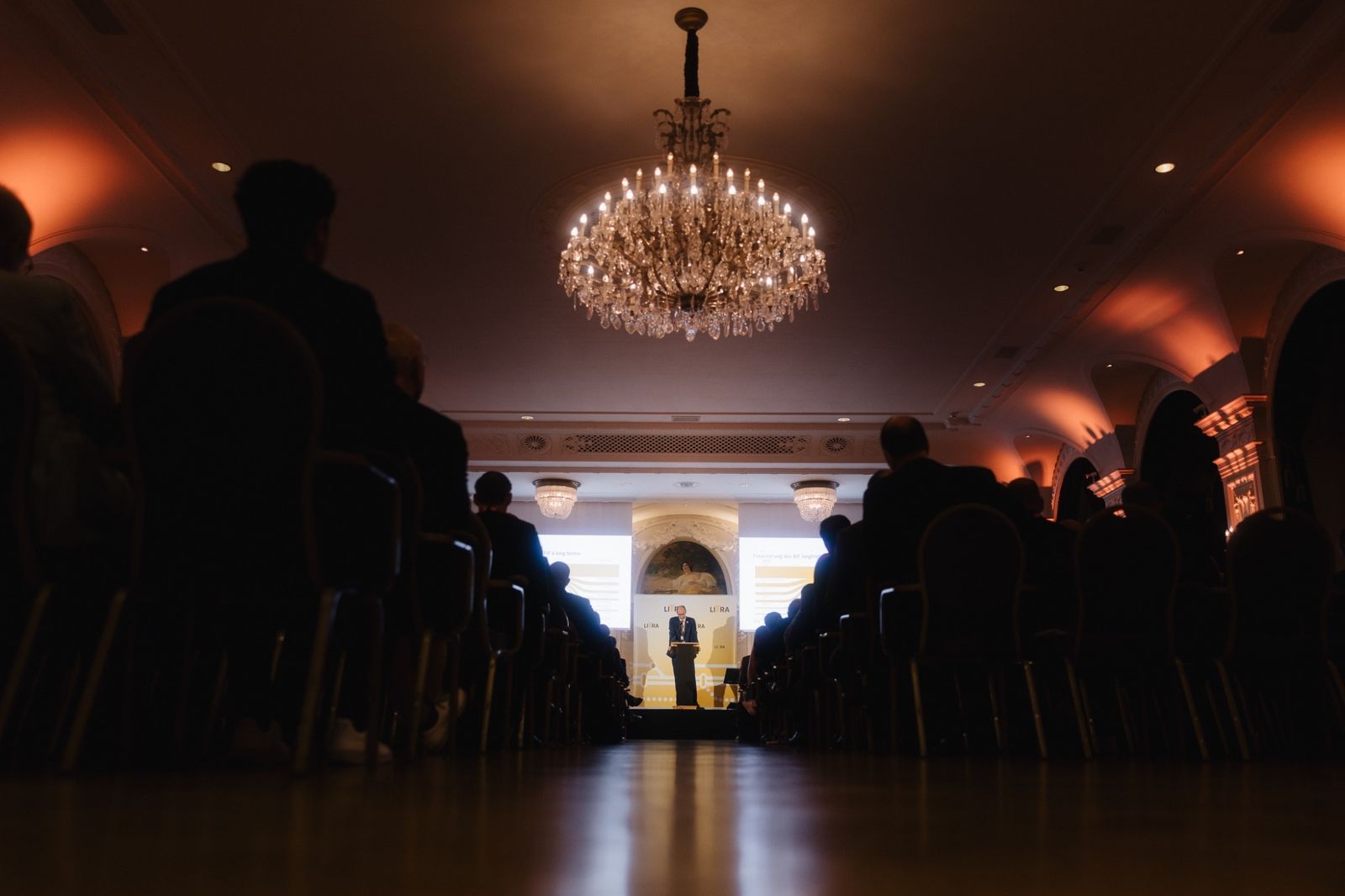
How many interpreters does an event need? The basic rule
In simultaneous interpreting, interpreters render a speech into another language almost in real time. Listening, understanding and speaking all happen at once. Nobody can keep up that level of concentration for hours on end.
That is why the professional association AIIC Switzerland sets this rule: at least two simultaneous interpreters work per language and booth. They take turns about every half hour. The one who is not speaking stays in the booth, listens and helps, for example by noting down figures and names or finding the right document.
For planning, this means: count the booths first, then double the number. The number of interpreters your event needs follows almost directly from the number of booths. On very long days, with packed programmes or difficult specialist topics, a team can also be larger. That is decided by the interpreters who take on the assignment.
Number of booths: one per target language
The number of booths depends on the target languages. The language spoken at the lectern is the source language; the language into which it is interpreted is the target language. There is one booth for each target language. For the channels on the receiver, however, every language in the hall counts, including the language at the lectern. Questions from the audience often come in another language and have to be interpreted into the language at the lectern. That needs its own channel.
What matters is the direction of interpretation:
- One direction: All speeches are in German, and part of the audience wants to hear French. You need one booth for French. Anyone who understands German listens to the speeches without a receiver. You still need two channels: if a member asks a question in French, it is interpreted into German.
- Both directions: German and French are spoken at the lectern, and the audience is mixed. Now both languages are target languages. Two booths are normally used: when a speaker talks in French, the German booth works; when she speaks German, the French booth works.
With two languages, some teams also work in both directions from a single booth. Whether that is suitable depends on the interpreters’ working languages, the subject and the duration. Clarify this directly with the interpreters.
Examples: interpreters and booths at a glance
| Event | Target languages | Booths | Minimum interpreters | Channels |
|---|---|---|---|---|
| General meeting in German, some members listen in French | French | 1 | 2 | 2 |
| Conference with speeches in German and French, mixed audience | German, French | 2 | 4 | 2 |
| Congress in English, interpretation for guests in German and French | German, French | 2 | 4 | 3 |
| National event in German, French and Italian, all into all | German, French, Italian | 3 | 6 | 3 |
| International conference in German, French, Italian and English | all four | 4 | 8 | 4 |
The table shows the minimum staffing.
Two notes on the examples. The congress in English needs three channels, even though only two booths are working: if questions from the audience come in German or French, the speaker has to hear them in English. How the booths share this between them is something to clarify with the interpreters. And with three or four languages, not every booth understands every source language. That is where relay comes in.
Relay interpreting with three or more languages
In relay interpreting, a booth does not listen directly to the speaker but to the interpretation from another booth. An example: a speaker talks in Italian. The French booth interprets directly into French. Nobody in the German booth has Italian as a working language. So the German booth listens to the French version and interprets from there into German.
Relay is common at multilingual conferences, but it has consequences:
- The interpretation reaches the audience with a slightly longer delay.
- Inaccuracies from the first booth carry over into the second.
- The interpreter desks must be able to receive the audio from other booths. Professional desks can do this; simpler solutions cannot always.
Sometimes a booth deliberately interprets from its native language into a foreign language so that other booths can take relay from it. This is called retour. You do not have to plan this yourself. What matters is that the interpreters know early on which languages will be spoken at the lectern and in the audience. They then put the team together so that every language is covered.
When whispered interpreting is enough
In whispered interpreting, the interpreter sits next to a few listeners and interprets quietly and simultaneously. No booth and no equipment are needed. This works when only a few guests need interpretation, for example a small delegation at a meeting otherwise held in German.
With a tour guide system, the interpreter speaks quietly into a microphone and the listeners wear receivers with earphones. This lets her reach a somewhat larger group, even on the move, for example on guided tours and factory visits. Tour guide systems are available through tourguidemieten.ch, by post or for collection in Zollikofen.
The limits: without a booth, the interpreter hears every noise in the room, and her voice disturbs the people sitting next to her. Whispered interpreting is not meant for long days or for several languages. Here too, longer assignments usually need two interpreters who take turns. Another option without a booth is consecutive interpreting: the speaker talks for a section, and then the interpreter renders it. However, this makes the programme considerably longer. You will find a detailed comparison of the equipment in the guide Tour guide system, interpretation system or app?
What this means for the equipment
Interpreter booths
Each booth needs a clear view of the lectern and the screen, a quiet spot in the hall, power and ventilation. Mobile interpreter booths can also be set up in halls without permanent booths, provided there is enough space. Mobile booths are covered by the EN ISO 17651-2 standard, which replaced the former ISO 4043 in 2024. Permanent booths are covered by EN ISO 17651-1.
Receivers and interpretation system
The interpretation reaches the guests via an interpretation system. With infrared, the signal stays in the room and cannot be intercepted. Every guest who needs interpretation gets a receiver with headphones and selects the channel for their language. Plan the number of receivers according to the guests who need interpretation, and allow for spares.
Microphones and conference system
Interpreters only hear what reaches the system through a microphone. Every speaker, the moderator and every question from the audience therefore needs a microphone. The sound from videos also has to be fed into the booths. For discussions with many requests to speak, a conference system with delegate units on the tables helps: every contribution then reaches the booths clearly.
Documents
Presentations, speech scripts and the programme should reach the interpreters in good time before the event. That way they can prepare technical terms, names and figures.
Equipment and interpreters from one provider
At Event-Solution AG, booths, interpretation system, receivers and microphones all come from one provider, looked after on site by our own technicians. We have over 1,000 receivers and up to 32 channels available. On request, we recommend or arrange the interpreters. Examples include the Recycling Congress at the Kongresshaus Biel and the general meeting of Küche Schweiz at the Volkshaus Biel, both with simultaneous interpretation. You will find more about the equipment under Simultaneous interpretation. We are happy to answer questions about planning your event: just send us an enquiry.